

How to value a business in Australia
A practical guide for owners before a sale, handover, or transition.
Start with a useful estimate.
The best first step is not to guess the perfect price. It is to get a realistic estimate or range and understand what could move the number up or down.
The usual starting point is maintainable earnings: the profit a new owner could reasonably expect the business to keep earning. From there, the estimate changes with size, business quality, buyer demand, and how easy the business is to hand over.
A buyer and seller then work toward a real price by looking at the details of the business. Two businesses with the same profit can still be worth different amounts because the details are different.
This guide is general education for business owners. It is not a formal valuation, tax advice, legal advice, investment advice, an offer, or a guarantee of sale price.
Request a free valuation estimate if you want a clearer starting point from a confidential conversation.
Work from maintainable earnings.
For many private Australian businesses, the practical model is: maintainable earnings multiplied by a sensible multiple.
Maintainable earnings may not be the same as the profit in the tax return or management accounts. Owner pay, family wages, personal costs, one-off costs, interest, depreciation, and unusual professional fees may need to be reviewed.
Some adjustments may be valid add-backs. Some may not be. A good add-back should be reasonable, documented, and linked to a cost that would not continue in the same way for a new owner. Read the add-backs guide before relying on an adjusted profit number.
The multiple is not a magic number. Size usually matters first: a larger and more stable profit base tends to support a stronger multiple than a smaller or uneven one. After that, the multiple changes with the details of the business: owner dependence, customer concentration, repeat revenue, staff, systems, location, cash needs, and the handover.
That is why a free valuation estimate is only a starting point. It can help you get a clearer view of value, timing, and possible options, but it cannot capture every detail that may make a business more or less valuable to a real buyer.
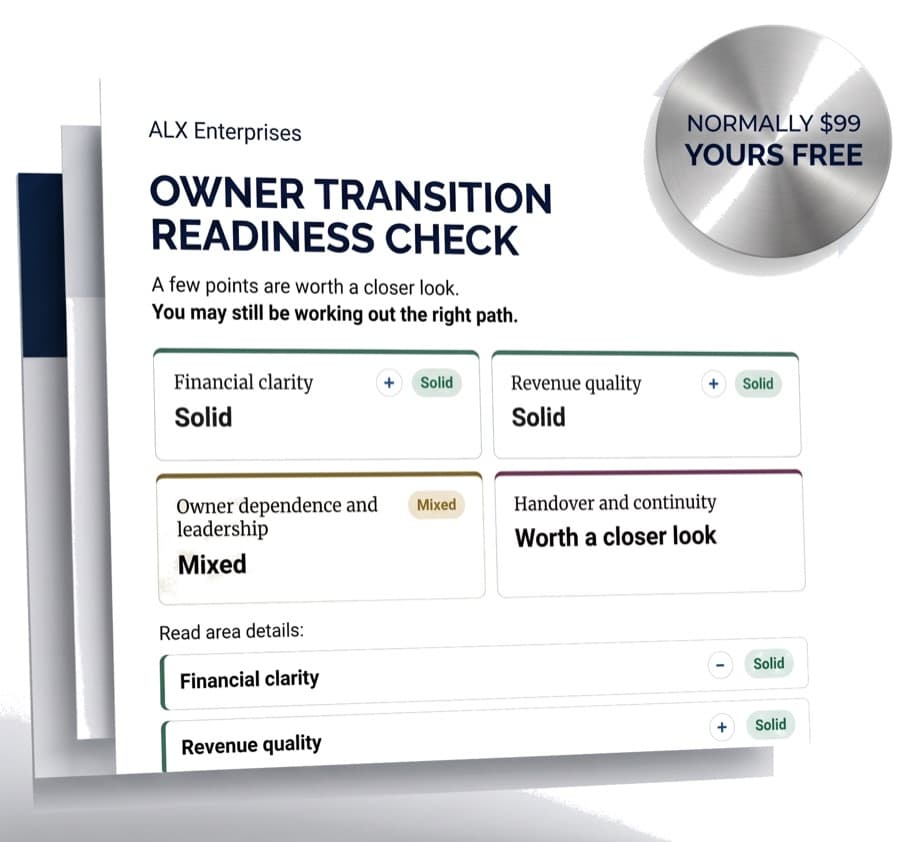
Find out how ready your business is for an ownership transition.
See what looks ready, what needs attention, and where to focus in under five minutes.
Know what changes the number.
Two businesses can earn the same profit and still be valued differently. Size is usually the main driver, then the details decide how strong the estimate should be.
Size is usually the main driver. A larger, stable profit base is easier for a buyer to understand, finance, and compare with other opportunities.
If customers, staff, suppliers, and key decisions all depend on the owner, the business is harder to transfer.
A business can be profitable and still carry risk if too much revenue depends on one or two customers.
Repeat, contracted, recurring, or relationship-led revenue usually gives a buyer more confidence than one-off work.
Capable staff, documented processes, and useful reporting make the business easier to hand over.
Stock, equipment, working capital, repairs, and reinvestment can change the price, terms, and cash needed after the sale.
Use the transition readiness scorecard if you want to test owner dependence and handover readiness more systematically.
Think like a buyer.
If you are valuing a business for sale, the number gets clearer when both sides look at the business properly: the profit, the work, the risks, the demand, and the handover.
Like any market price, value is affected by supply and demand. A business may be worth more to one buyer than another because of location, fit, timing, skills, staff, customers, or what the buyer can do with the business after they own it.
Be clear about whether the sale includes the operating business, assets, stock, name, systems, leases, licences, customer relationships, contracts, data, goodwill, or only some of these.
A buyer will separate normal earnings from one-off projects, temporary conditions, personal costs, owner-only relationships, and weak add-backs.
Customer concentration, key staff risk, supplier dependence, lease issues, compliance gaps, old equipment, and working-capital needs all affect buyer confidence.
A simple handover supports a cleaner price. A harder handover may still work, but it can affect timing, conditions, deferred payments, or the owner's transition role.
A stronger business does not avoid negotiation; it gives both sides better evidence to work from. A weaker or harder handover does not mean there is no value, but it can change the price, terms, and support needed after the sale.
Prepare the evidence.
You do not need a perfect data room before a first conversation. You do need enough clarity to separate a useful estimate from a guess.
Pull two to three years of accounts and identify owner wages, family wages, personal costs, one-off costs, interest, depreciation, and unusual professional fees.
Only rely on add-backs you can explain clearly and link back to a cost in the accounts.
Break revenue into repeat, contracted, recurring, project, and one-off work. Note customer concentration and the pipeline a buyer could realistically inherit.
List the decisions, relationships, approvals, technical work, and informal processes that still sit with the owner.
Prepare a clear view of assets, stock, leases, licences, supplier arrangements, staff roles, systems, domain names, and intellectual property.
Better evidence usually improves the conversation. Sometimes it supports a stronger estimate. Sometimes it reveals a risk that should be fixed before going to market. Either outcome is more useful than pretending the first number is certain.
Claim your free valuation estimate.
Find out what your business could be worth.
Request a confidential estimate and replace the guessing with a clearer view of value, timing, and possible options to start building a sensible plan.

Common valuation questions.
Short answers to the questions owners usually ask before requesting an estimate or starting a conversation.
How do I calculate what my business is worth?
Start with maintainable earnings, then apply a multiple that reflects size, business quality, and how easy the business is to hand over. That gives a realistic estimate or range to work from. The real price becomes clearer when the seller and buyer look at the actual business together.
Should I use revenue or profit?
For most established private businesses, profit is usually more useful than revenue because buyers care about the cash the business can keep producing. Revenue still matters because it helps explain scale, repeat work, customer concentration, and growth.
What multiple should I use?
There is no single multiple that fits every business. Size and profit usually matter most. After that, the multiple changes with owner dependence, customer concentration, repeat revenue, staff, systems, location, and how much work is needed after the sale.
How do I value a business for sale?
Start with profit and a sensible multiple, then look at the actual business: what is included, what profit continues, what needs fixing, who runs the work, and what support is needed after the sale.
Is an online estimate accurate?
A quick estimate can be a useful starting point, but it cannot see every detail: records, contracts, staff, location, buyer demand, handover, or the things that make one business more attractive than another. Treat it as a starting point, not a formal valuation or final sale price.